
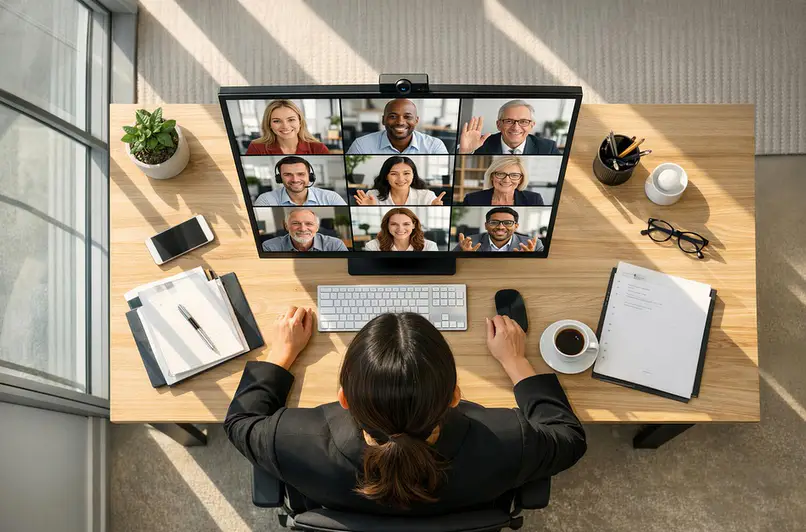
Remote work has been built on the same promise for years: staying productive regardless of location. But in 2026, something fundamental is shifting. AI agents are taking over tasks that previously only human colleagues could handle. They analyse documents, prepare meetings and contribute to strategic thinking. Not as a passive tool, but as an active participant in the work process.
From search function to thinking partner
Not long ago, AI was little more than a smart search function for most remote workers. You asked a question and got an answer. That era is over. The current generation of AI agents can maintain context across long conversations, contribute to complex problem-solving and independently execute subtasks. Think of drafting a project proposal based on earlier notes, or summarising customer feedback from dozens of emails.
For remote workers, this is a significant leap. Working alone from home often means missing the spontaneous exchange of ideas that happens naturally in an office. An AI agent partially fills that gap. Not as a replacement for human interaction, but as a thinking partner that is always available.
Small teams, big impact
One of the most striking developments is how AI levels the playing field. A team of three freelancers can now execute tasks that previously required a department of ten. The AI handles data analysis, content creation and planning logistics. The human steers, monitors quality and makes the strategic calls.
This makes remote work not only more feasible but also more attractive for small organisations and independent professionals. You no longer need a large office to operate professionally. Technology compensates for what you lack in headcount.
Trust and security
Yet this shift also introduces risks. When AI agents gain access to sensitive business documents, client data and internal communications, cybersecurity becomes far more pressing. Especially for remote workers operating through home networks and personal devices.
Organisations deploying AI for their remote teams need to invest in clear security protocols. Every AI agent needs a well-defined role with limited access rights and transparent logging of how data is used. Trust in the technology starts with containing the risks.
New skills for a new era
The rise of AI agents also changes what is expected of remote workers. Purely executional work is losing its value. What matters is the ability to set direction, evaluate critically and communicate clearly with both people and machines. Someone who can articulate precisely what is needed will get more out of AI than someone who is technically stronger but less precise in their communication.
Upskilling is therefore becoming a necessity, not a luxury. Not just in using specific tools, but in developing judgement and creative thinking. Precisely the skills that AI cannot replicate.
The conclusion is straightforward. AI does not replace the remote worker, it redefines what remote work can be. Those who learn to collaborate with AI agents do not become redundant. They become more capable.